A Not-so-Lonely Planet

I’m not Lonely Planet’s biggest fan.

Why? You ask.

Because in many ways they uphold the very same ideas that they supposedly seek to get rid of.

Mark Twain (n.d.) famously wrote: “Travel is fatal to prejudice, bigotry, and narrow-mindedness, and many of our people need it sorely on these accounts,” and Lonely Planet (LP) too believes travel can be a force for good, reducing cultural differences and inequalities. 

Travel can certainly be beneficial in many ways (Harrison 2006) – the world is beautiful and full of wonder and I won’t deny that. However as one of the biggest drivers of human mobility across the world, it does play a vital, and sometimes problematic role in “the process of identity formation, the making of place, and the perpetual invention of culture” (Salazar, 2014 p. 16)

Whilst I don’t necessarily disagree, my problem is that the notion that travel is the best way of getting rid of narrow-mindedness, is based upon the assumption that ‘foreign’ cultures are unknowable in the first place, and it is only by spending time with these Others that the traveller can accept their shared (albeit, diverse) humanity, rather than it being a given despite their perceived differences.

This process of inspiring change within the traveller is often founded on a binary between the self and an exotic Other, where the self travels to “’exotic’ third world destinations” that bear absolutely no similarity to the world the traveller has come from. LP features predominantly Western writers providing information for other Western travellers about ‘exotic’ (read: non-Western/alien) destinations with language that heavily emphasises the traditions and “Otherness” of the people they write about. By privileging the Western Orientalist voice over the local, it becomes a vaguely colonialist form of communication that only further marginalises people outside of the “Western world” – they are unable to create themselves, rather, they are whatever the writer shapes them into being.

Kuthodaw Pagoda, Mandalay

This is not just me as an anthropology student blowing things out of proportion; Soranat Tailanga’s (2014) research into the influence of English travel writings on the tourist’s conceptualisation of Thailand found that this medium is particularly powerful in influencing the tourist’s perception over a country and culture. Take the way LP writes about Myanmar (Burma), for example. A country in the exotic South East Asia, it is described as a place where “the traditional ways of Asia endure” (LP 2019), and exploring it can “often feel like you’ve stumbled into a living edition of the National Geographic, c 1910! For all the momentous recent changes, Myanmar remains at heart a rural nation of traditional values” (LP 2019). This language is quite problematic; particularly since you don’t find LP writing about the “traditional ways” of England, America or Australia. These Western places are not exotified, rather it is the charm of their cities and landscapes that provide the traveller with fulfilment rather than the people. An implication emerges, then, that exotic cultures, with their strange traditions and ways of life exist, are frozen in time, for tourist consumption and benefit.

An example of the aesthetically displeasing Mandalay

This idea of culture as static is only exacerbated when a city has the audacity to industrialise and the familiarity of it loses a city’s exotic, alien appeal. According to LP, Mandalay, Myanmar’s second largest city “will never win any beauty contests” (LP 2019) due to the “haphazard construction boom that was never about aesthetics. An ever-growing number of motorbikes and cars clog the roads, too, making for a sometimes smoggy city” (LP 2019); “beyond a functional grid, it doesn’t have a ton of immediate appeal” (LP 2017). Maybe this is just my subjective opinion, but I don’t think “foreign” cities exist to appeal to a tourist’s aesthetics, just as people in these places don’t live to aid the tourist in their process of self-discovery. Culture is not guarded by an Other, neither is it so inherently incomprehensible to the Western traveller that it is something that has to be experienced to be believed. Rather, the “culture” one seeks is more likely people just trying to live their own ordinary, startlingly familiar lives. Essentially, tourism elevates these cultures into something exotic and magical, where the people of this culture merely just see it as their boring, everyday life.

Singapore, with its melting pot of cultural influences, has long been dismissed as a sterile stopover (LP 2017) – likely due to the fact that it is clearly an industrialised nation, in many ways strikingly familiar to the Western gaze.

There are a lot of similarities that can be drawn between travel and ethnographic writing. Like anthropology, travelling involves “the human capacity to imagine or to enter into the imaginings of others” (Salazar, 2014 p. 1) for a particular audience, often to better understand and overcome inequalities in this world. However that also means that they are often complicit in upholding structures that silence and strip agency from the very same people they write about. The ethics of travel and representation are becoming increasingly complicated, both as a tourist and as an anthropologist, but it doesn’t take much to explore this world with a slightly more critical eye.

Banner Source: LP

(All other images are my own)


References:

Abbie’s Emic vs Etic article

Harrison, J 2006, ‘A Personalized Journey: Tourism and Individuality’, in V. Amit and N. Dyck (eds.), The Cultural Politics of Distinction, Pluto Press, London, pp. 110-130.

Imogen’s articles on Anthropology’s past and Ethnocentrism

Lonely Planet 2017, Introducing Mandalay, viewed 1 June 2017, <http://www.lonelyplanet.com/myanmar-burma/mandalay/introduction>

Lonely Planet 2019, Introducing Mandalay, viewed 7 June 2019, <http://www.lonelyplanet.com/myanmar-burma/mandalay/introduction>

Richmond, S 2019, Introducing Myanmar (Burma), viewed 7 June 2019, <http://www.lonelyplanet.com/myanmar-burma/introduction>

Lonely Planet 2017, Introducing Singapore, viewed 1 June 2017, <http://www.lonelyplanet.com/singapore>

Salazar, N.B., and Graburn, N.H.H., 2014, Tourism Imaginaries: Anthropological Approaches, Berghahn Books, New York.

Talianga, S 2014, ‘Thailand through travel writings in English: An evaluation and representation’, Kasetsart Journal of Social Sciences,  vol. 37, pp. 1-6.

Twain, M n.d. (orig. publ. 1869), The Innocents Abroad, Harper & Row, New York.

See Also:

Lani’s article on Eat, Pray, Love

Johnson, A.A. 2007, ‘Authenticity, Tourism, and Self-discovery in Thailand: Self-creation and the Discerning Gaze of Trekkers and Old Hands’, Sojourn: Journal of Social Issues in Southeast Asia, vol. 22, no. 2, pp. 153-178

Kraft, S.E. 2007, ‘Religion and Spirituality in Lonely Planet’s India’, Religion, vol. 37, no.3, pp. 230-242.

Kravanja, B 2012, ‘On Conceptions of Paradise and the Tourist Spaces of Southern Sri Lanka’, Asian Ethnology, vol. 71, no. 2, pp. 179-205

Lisle, D 2008, ‘Humanitarian Travels: Ethical Communication in “Lonely Planet” Guidebooks’, Review of International Studies, vol. 34,  pp. 155-172

Beyond Academia: what else can you do with your anthropology degree?

The notion of what ‘the field’ is in anthropology has been expanding over the last few decades. As anthropologist Clifford Geertz is famously quoted saying: ‘The locus of study is not the object of study. Anthropologists don’t study villages (tribes, towns, neighborhoods…); they study in villages.’ (1973, p. 22). Even studying in villages is a bit antiquated in anthropology these days—many anthropologists study communities of practice that occur in many locations or studying the webs that link people and non-human beings across many locations.

But what do anthropologists do if they aren’t researchers in academia…? Not surprisingly, the work that anthropologists do is similarly diverse and expanding.

I interviewed (with Lani’s help) four anthropology graduates and asked them what kind of work they are doing now and how their anthropology degrees have helped them. Maybe it was just a coincidence, or maybe it says something about job opportunities available to anthropologists but two of the five people interviewed worked in user experience and two of the four worked in product design. Meet the interviewees:

Katie

Studied: a Masters in design anthropology (applied anthropology)

Works as: a consultant at a small consultancy Elabor8 on internal employee culture and engagement and product design.

Previously worked: doing user experience at Australia Post

Pasquale

Studied: Anthropology (Honours) and a post grad diploma in IT.

Works as: a user experience consultant at an IT company

Previously worked: in television

Isabella

Studied: Anthropology and Media & Communications

Works as: a freelance digital marketer doing marketing and product design

Paulina

Studied: Anthropology and Social Theory

Works as: a journalist, writer, university journalism teacher and a researcher at the Polish Academy of Sciences working on an argument about contemporary food culture

Previously worked: as an ESL teacher and freelance journalist and as a reporter for Fairfax Media (before it was taken over by Nine), the Polish Press Agency and the Guardian

A side note: I realise this is a bit of a long article, but the following are answers from each interview (either in audio format, transcribed, or notes that I took from a conversation that wasn’t recorded) and edited by myself to answer some broad questions that any job seeker may have. Feel free to skip through and follow the thread of a particular person who you find relatable to your interests, or read all the answers to a particular question that interests you! I hope you enjoy and feel a bit more comfy in your outlook for the future–I know it can be scary wondering what you will do after you finish your degree.

Why is anthropology useful in your work?

Overview: Generally anthropology was seen as useful to people’s work because it has taught them to listen and empathise with other people, to try to understand their behaviour and their lives. This understanding enables the interviewees to solve problems that their customers or clients identify themselves.

Katie:

Pasquale: ‘Anthropology is really about learning how to understand people, how to understand behaviour, how to understand what’s happening. And more and more organisations now really want to know what’s going on, because they realise now that they haven’t been listening, that they haven’t understood about their clients, their customers, their users. They haven’t even really understood their business all that well. And the great thing about anthropology is it gives you tools like ethnography, and, you know, the way you think about bias and what you are bringing to the work, which I think actually helps companies a lot.’

‘The first step in a design thinking model is you’ve got to empathise with the people who are the target of your project. Well, how do you do that? That’s what people learn when you do anthropology: is how to empathise, how to understand what’s going on, how to make sure you’re not bringing your biases to your work, how to make sure you can get information even when you may not have proper access to people. All of that, they’re all things that anthropologists learn to do and work out on a regular basis…It’s also important at other points in the model when you are trying to define the problem. You want to define the problem with the people, not just make it up as you are going along. When you try to come up with other ideas, you want to bring the people along, so that you can brainstorm those ideas. When you are actually prototyping things, you want to make sure you are including them so they can give you a sense that this thing is going to work or not. So throughout that whole design thinking methodology there’s just anthropology at various points, as far as I’m concerned.

Isabella:

Paulina: ‘I think what anthropology taught me was to always analyse the categories we take for granted. Not everybody lives the same, not everybody eats the same and not everybody dies the same. I see over and over again how normative some journalism/writing/academia can be — constantly reaffirming the same structures and the same processes without looking for the differences and contradictions. I grew up bicultural and bilingual, so I already knew this on some level, but anthropology gave me the necessary disciplinary training to analyse it.’

Are there many other anthropologists in your field?

Overview: As anthropology graduates, the interviewees generally felt like they were quite unique in their fields, with the exception of user experience, IT, and marketing being growing fields for anthropologists because companies are seeking them out for the skills and knowledge that they bring. People with social work, legal, psychology, sociology, politics, and history backgrounds often do similar types of work to anthropologists. An anthropology degree can bring an advantageous edge that others don’t have because anthropologists ask different kinds of questions, use different sorts of methods and get different results.

Katie:

Pasquale: ‘Early on I would have said there weren’t that many, but I think what’s happening now particularly in areas like IT, people are looking at anthropology and ethnography and they actually like what they see, because they want people that can be comfortable in planning and in going in and investigating what’s going on somewhere, or what people are thinking…There is a fast growing area of user research…or UX research (which is slightly different)’

Isabella:

Paulina: ‘I think most people writing about Poland for English-language publications — if I restrict it to this example — are politics or history majors. Many of them seem to have done PPE-style degrees at OxBridge-type institutions. They do really good work, but again, some of them seem to reaffirm structures instead of questioning them (reporting on the state and its institutions as if liberal democracy is the only thing to have ever existed), which during this period of political meltdown is more than a little problematic. Anthropologists ask different questions and I think the more they participate in public discourse, the better we will all be. So get to it!’

What are some thoughts and advice for finding the right work using your anthropology degree?

Pasquale: ‘In the mean time you may have to take up jobs that aren’t that funky. But I think once you’ve realised you want to go in a certain direction then you just keep trying to get into that area.’

Paulina: ‘While I was freelancing, I worked as an ESL teacher in Poland and Australia, which was a great fall-back job (actually, teaching is probably the most useful thing I have ever done). And what better place to flex your anthropological muscles than in another country, in a cross-cultural context.’

A note on writing from Paulina: ‘Writing, on the other hand is a lifelong pursuit with no certain outcome. Being instrumental about it can kill it, being too idealistic about it can kill it too — you shouldn’t do it unless it’s something you feel you need to do. Definitely don’t do it if you want people to like you — they won’t.’

Some final advice from Katie


See more:

Geertz, C 1973, The Interpretation of Cultures, New York: Basic Books.

[Images my own from my travels around this continent – I hope they make you feel as calm as they make me feel.]

Battle of the Ethics: Subsistence Looting

“Some of the 700 Iraqi antiquities…recovered from smugglers along the Syrian-Iraqi borders. Antiquities were looted from Iraq amid the chaos of the 2003 U.S.-led invasion that toppled former Iraqi President Saddam Hussein.” AFP PHOTO/LOUAI BESHARA

In a previous post, I talk about precarity.

My affair with Anthropology post-dates my commitment to Ancient World Studies – the one subject in high school that really interested me. Yet, for me, the most compelling part of the textbook wasn’t actually about the ancient past itself, but the politics of its afterlife: archaeological ethics, repatriation, conservation, 3D-printing and other technologies used in reproduction. The events of 2015 in Palmyra, Syria, including the grievous iconoclasm – that is, the destruction of monuments for religious or political purposes – and Khaled al-Asaad’s refusal to give up the location of ancient artefacts at the cost of his life, cemented my aspirations in becoming an archaeologist and helping safeguard the relics of the past from similar atrocities.

So, when I was speaking to an Ancient World Studies PhD student earlier this year about my interest in anthropology and archaeological ethics, she suggested taking a free online course called Antiquities Trafficking and Art Crime, developed by Dr. Donna Yates at the University of Glasgow. It’s four weeks long, requires no existing knowledge on the topic, and is truly fascinating. I don’t think it’s entirely without fault, but it has some great (mysterious! unresolved!) case studies and encourages active engagement with your instructors and fellow learners, just like an actual class. Overall, I would highly recommend it as an entry point to learning about the theft, trafficking and forgery of art and antiquities.

What I found really interesting about the course was that it offered a distinctly anthropological perspective on looting that I’d previously never considered. When archaeology students learn about the practice of looting, we’re told one thing: the context of the artefact is lost forever, which means we’ll never know how the artefact relates to the site, period, or assemblage, and, consequently, the complete reconstruction of the archaeological record becomes impossible. As Cannon-Brookes (1994, p. 350) argues, artefacts without context are “cultural orphans…virtually useless for scholarly purposes”. With such unequivocally negative representations of looting, it’s difficult to re-imagine how else this narrative can be told.

But if there’s anything anthropology has taught me, it’s that there’s always another side to the story, a side that’s underrepresented or silenced by a more dominant voice. As Dr. Yates (2019) contends, the idea of looters as grave robbers and tomb raiders is far too simplistic. Many of the countries which harbour prolific black markets “have rich archaeological pasts but are economically poor” (Yates 2019) – an effect largely borne by colonialism and conflict, the historic and current imbalances of which continue to perpetuate chronic poverty, health insecurity, and political corruption and instability. These all contribute to an environment characterised by precarity, which forces those living in poverty to turn to “last resorts” like the illicit antiquities trade. A perspective that can provide more emic insights is evidently required by this multifaceted phenomena, and it’s a conversation that anthropology is positioned to initiate.

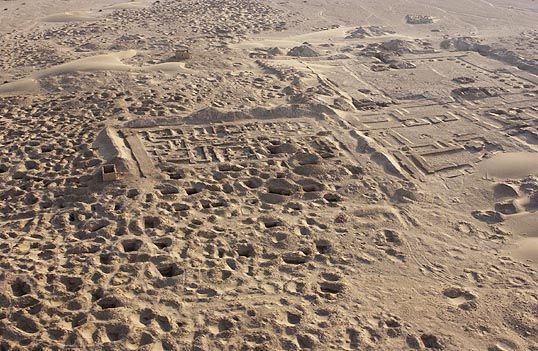
The pockmarks of looted sites are often compared to the craters of the moon. Source.

People who engage in illicit excavation for “saleable cultural objects due to extreme poverty” are known as “subsistence looters” (Yates 2012, emphasis added; Hollowell 2006). “Subsistence” here implies that the individual is economically disenfranchised: “they are looting for survival, not profit” (Yates 2012). Indeed, profit is almost inconceivable, as Borodkin reports, with looters receiving less than 1% of the final selling price (1995, p. 378). That’s not the only loss looters face: a destroyed site loses its potential for archaeological tourism. The antiquities black market therefore exploits the looters’ precarity, cyclically robbing them of the possibility to invest in a longer-term economically stable future.

Now, I’m not condoning the looting and trafficking of antiquities, but it no longer seems so straightforward to blame looters for putting their basic needs before the preservation of the archaeological record, nor does it seem fair to view looters as the sole perpetrators of the practice. If anything, as Renfrew and Elia (1993) argue, antiquities collectors are accountable for the demand that looters respond to – a demand that originates in the imperialist practices of 17th- and 18th-century Europe.

The sentiments of the academic, authoritative archaeologist have been the most vocal in the vilification of looting. Whilst this has taught student archaeologists that looting is bad and that we shouldn’t do it, this representation hasn’t helped the humanisation of looters nor the prevention of looting. This issue invites a dialogue on ethics between anthropologists and archaeologists to devise a collaborative solution.

Elia (Renfrew and Elia 1993, p. 17) asserts that “the only way to make a dent in the looting problem is to reduce the demand for antiquities by bringing about a change in social attitude whereby collecting is no longer considered socially acceptable.” I think this is true, but it’s still an archaeologist-centric view. Hardy (2012), on the other hand, has found that community-based practices such as education on the value of heritage and the founding of local museums for cultural tourism have been effective in reducing illicit antiquities trafficking in Mali. I would also imagine long-term solutions to economically support subsistence looters and the concurrent prohibition of museums from acquiring artefacts without context would deter the practice as well (a policy that some, but not all, museums have adopted): an artefact with zero value provides no incentive for looting, but it’s imperative that alternative economic opportunities are made available.

Ultimately, there needs to be a reconsideration of looting as a one-dimensional practice, with anthropology playing an important role in diverting focus toward what causes people to resort to subsistence looting in the first place, rather than fixating on its effects on the archaeological record.


References:

Borodkin, LJ 1995, ‘The Economics of Antiquities Looting and a Proposed Legal Alternative’, Columbia Law Review, vol. 95, no. 2, pp. 377-417.

Cannon-Brookes, P 1994, ‘Antiquities in the market-place: Placing a price on documentation’, Antiquity, vol. 68, no. 295, pp. 349–50.

Hardy, SA 2012, ‘looting, the subsistence digging economy in Mali; and stemming the flow of looted antiquities from Mali to the USA’, weblog post 3 April, WordPress, viewed 14 May 2019, < https://conflictantiquities.wordpress.com/2012/04/03/mali-looting-export-usa-import/>

Hollowell, J 2006, ‘Moral arguments on subsistence digging’, in C Scarre & G Scarre (eds), The Ethics of Archaeology: Philosophical Perspectives on Archaeological Practice, Cambridge: Cambridge University Press., pp. 69-94.

Renfrew, C & Elia, R 1993, ‘Collectors are the Real Looters’, Archaeology, vol. 46, no. 3, pp. 16-17.

Yates, D 2012, Subsistence Digging, viewed 14 May 2019, <https://traffickingculture.org/encyclopedia/terminology/subsistence-digging/>.