Embrace the Serpent: Representing Anthropological Relationships

Karamakate, Theo, Manduca (R-L)

Embrace of the Serpent is a 2015 film by Colombian director Ciro Guerra that shows two anthropological journeys into the Colombian Amazon. It cuts between two timelines, 1909 and 1940, to show two journeys up the Colombian Amazon by Western researchers Theo and, later, Evan—who are based on ethnologist Theodor Koch-Grünberg and ethnobotanist Richard Evans Schultes. In the film, the two journeys are connected through the single character, Karamakate, a shaman and their guide. Karamakate is one of the surviving members of a fictionalised tribe, who have access to powerful medicinal plants, that Theo believes he needs to survive. The film blends Amazonian mythology with the diaries and writings of the Koch-Grünberg and Evans Shultes, depicting these journeys from the indigenous point of view as much as the explorers’. In an interview Guerra says that,

in order for the film to be true to that [the indigenous point of view], I had to stop being faithful to the “truth” because, to them, ethnographic, anthropological, and historical truths were as fictional as imagination and dream, which for them was valid. (Guerra, 2016)

Guerra worked with local indigenous communities in the writing and production of the film and, after the film’s premiere in Venice, it was screened a number of times in the Colombian Amazon. The film is spoken in nine languages, one of which, Ocaina is only spoken by sixteen people, and Guerra says that it was a powerful experience for them to see their language represented on the screen (Guerra, 2016).

Embrace of the Serpent, while a kind of parable or mythological story, gives a complex depiction of field relationships between the two social scientists and their indigenous interlocutors. They are characters that are sympathetic to the indigenous Amazonians, with Guerra on stating that Koch-Grünberg was, “the first to refer to the indigenous people in humanistic terms as the people of the Amazon” (Guerra, 2016). And they are shown in a very good light in comparison to the other Europeans of the film, who are either missionaries or rubber barons. The gravely ill Theo travels with Manduca, who is local and loyal to Theo because he payed out Manduca’s debt to the rubber plantation. Yet both Theo and Evans, as characters, have a ‘dark’ side to them, they are conceited and can’t full empathise with the local tribes and, at times, their attempt to extract knowledge without considering the indigenous perspective emerges.

In one scene, a tribe that Theo has visited before, and seems to be on good terms with, steals his compass. He confronts them and grabs one of the children pushing him to try and get it back.

Karamakate: You’re nothing but a white 
Theo: Their orientation system is based on the winds and the position of the stars. If they learn how to use a compass, that knowledge will be lost.
Karamakate: You cannot forbid them to learn. Knowledge belongs to all men. But you can’t understand that, because you’re just a white.

Here Theo’s obsession with maintaining the purity of ‘traditional’ local knowledge turns into a form of paternalism, in which he feels he knows what they should want or need better than they do.

Embrace of the Serpent skilfully balances the complexity of representing historical anthropological research. It depicts multiple relationships that developed and change between the characters, as individuals not just archetypes, throughout these journeys. Manduca and Karamakate are not simply victims, rather they choose to help the white interlopers and, for good and bad, feel like these researchers were their best shot at telling their stories to the colonisers and capitalists that were destroying their communities.

Guerra doesn’t shy away from the uncomfortable actions and opinions of the researchers, and yet, these relationships are never ‘black and white’. Well, in a literal sense, they actually are because the film is shot using black and white 35mm film. The decision to shoot without colour was originally inspired by seeing the old daguerreotype photographic plates, which were “devoid of exuberance and exoticism”, and then going to the Amazonian jungle Guerra realised that colour film couldn’t begin to really represent the multiple colours there (Guerra, 2016). It also has another effect, which I found shone through when watching the film:

“[W]hen I talked to the Amazonian people, I realized that with black-and-white images there was no difference between nature being green and us being something else. Every human, every bird, every drop of water is made up the same in black and white so it was perfectly coherent. ” (Guerra, 2016)


References:

Embrace of the Serpent 2015, video recording, Ciudad Lunar Producciones, Colombia. Directed by C Guerra

Guerra, C., 2016. Embrace of the Serpent: An Interview with Ciro Guerra [WWW Document]. Cineaste Magazine. URL https://www.cineaste.com/spring2016/embrace-of-the-serpent-ciro-guerra (accessed 6.9.19).

Empty Signs / Quotidian Ruptures

IMG_0717.jpg

Visual anthropology is a broad area of anthropology that encompasses the study of visual systems, the use of (audio)visual tools to do research, and these tools as ways of representing the research (Banks, 1998).

Historically visual anthropology pretty much equalled ethnographic film, but more and more researchers use photography, film and drawing to think about and to represent the field site. Anthropology is still heavily text-based and often images are only illustrative (rather than influencing the argument or research), but there is increasing use of experimental forms to stretch the possibilities of understanding people’s life-worlds (Pink, 2006).

IMG_1693.jpg

I find photography an important way of paying attention to the things around me – I start to see slightly different. I often build up archives of photos of particular things I notice and photograph over and over.

Such archives become things to think with.

As in the case of these photos of empty billboards I took in Chile in 2017.

IMG_1522.jpg

Surely much anthropological thought happens in the finding those gaps in the researcher’s everyday life. Fissures between expectation and experience. Things that take you by surprise. Arts of noticing, as Anna Tsing might call it.

For me, these billboards are not only an example of acts of noticing. The more I look at them, the more I see them as visual metaphors for the processes of noticing those things that hide in plain sight. They depict the gaps in the fabric of everyday life, gaps of understanding, that stand out in their quietness. 

IMG_1211.jpg

These billboards stand out in their emptiness and quiet.

IMG_1699

I don’t think I’ve ever seen an empty billboard in Australia.

Whereas I was finding myself asking

 – why are there so many empty billboards in Santiago?

-and why are there so many in Australia?

IMG_1440

Is it from a slowing economy? With a slackening of consumerism perhaps, this advertising space isn’t necessary anymore?

IMG_1695.jpg

Or perhaps Chileans just don’t see it like that? Perhaps they have a much less regimented idea of public space, no need for the ‘completeness’ of an environment.

(Admittedly  I never asked anyone about it, so I didn’t conduct proper research around it).

To me these photos provide a provocation around public space. The shocking lack of advertising makes me realise its total ubiquity. And it provides a kind of visual hope too, that perhaps gaps in the totality of consumerism is possible. I only really notice advertising through when it disappears, and it is replaced with a series of Robert Hunter paintings.

Untitled no. 1, Robert Hunter, 1987

Research(ing) Fields / Anthropology of Food

My honours thesis is about coffee so I’ve been reading a lot about the anthropology of food, which is a larger subfield than I had realised. As a research area it is interesting because it allows for multidimensional research that links together ecological concerns with economics and symbolic and ritual meaning-making. Food studies also directly connects the body with these wider social-cultural-economic systems. Because of the way that food travels, or not, it also can be at the forefront of multi-sited ethnographic research.

In an overview of the subdiscipline, Sidney Mintz describes three areas that the anthropology of food focuses on (Mintz and Du Bois, 2002):

  1. Political-economic value-creation
  2. Symbolic value-creation
  3. Social construction of memory         

Mintz, himself, is the author of Sweetness and Power (1986)a very influential book that gives a history of the modern era through the lens of sugar. As one of the most important global commodities, sugar has always been embedded in colonial economic relationships.  His fieldwork in Puerto Rico with sugar cane labourers led him to think about the history of the commodity in shaping both the producing nations and the consuming nations. He ties together the economics (demand/supply) of sugar with its changing social meaning.

The research field, for Mintz, started in the sugar cane fields of Puerto Rico, but he believed that in order to understand these economic and power relationships required a historical and transnational lens, paying attention to the ways in which meaning is made through use. Mintz sees the production and consumption influencing each other in complex ways, just like the intertwined relationships between the economic, geopolitical and cultural spheres.

In doing so he uses the ‘follow the thing’ research method, which traces a single object as it passes through different exchanges and social spheres (Marcus, 1995). The object in such research is often seen as being made of up a multitude of social relationships.

Studying food is also about the connection between these larger social practices and one’s sensory experience. The sensory experience of food is critical to a fuller understanding of people’s relationships to it. How can anthropology describe sensory experience? One example of the increasing attempts to tackle this problem is Sarah Pink’s ethnographic description of a Slow Food Movement walking tour in Wales (Pink, 2008). Pink takes a cue from the slow food walking tour to propose a multimodal ‘slow ethnography’ that embeds itself in the places sensory experience of being there (Sutton, 2010). This then allows Pink to understand ethnography itself as a “place-making process”, shared between researcher and participants (Pink, 2008, p. 175).


References:

Marcus, G.E., 1995. Ethnography in/of the World System: The Emergence of Multi-Sited Ethnography. Annual Review of Anthropology 24, 95–117.

Mintz, S.W., 1986. Sweetness and Power: The Place of Sugar in Modern History. Penguin Books.

Mintz, S.W., Du Bois, C.M., 2002. The Anthropology of Food and Eating. Annual Review of Anthropology 31, 99–119. https://doi.org/10.1146/annurev.anthro.32.032702.131011

Pink, S., 2008. An urban tour: The sensory sociality of ethnographic place-making. Ethnography 9, 175–196. https://doi.org/10.1177/1466138108089467

Sutton, D.E., 2010. Food and the Senses. Annual Review of Anthropology 39, 209–223. https://doi.org/10.1146/annurev.anthro.012809.104957

Things We Wish We Knew in First Year: The ‘Field’

Source

Where do anthropologists do anthropology? Where do they participate and observe and collect data from which to write ethnography (link)?

The field!

Fieldwork is what anthropologists do, alongside constructing and analysing cultural theory, in order to answer the questions they construct. The field can be a village, a town, a city, a neighbourhood, a country, a border, a journey, a combination of any of these things simultaneously, a political debate, an archive, a multi-player online game, a social media platform; it can be anything where people are, physically or otherwise. It can be a literal field, if that is where people are doing something interesting. Some academics defy even that caveat of human presence, exploring multispecies ethnography to tackle anthrocentrism (Kirksey and Helmreich 2010), or probing the possibility of an anthropology of absence and the ‘spectrally resonant spaces of culture’ (Armstrong 2010).

Gupta’s writing on ‘the field’ as constituting site, method and location in anthropology is useful for unravelling the various dimensions of this term. Gupta argues that locations in anthropology are political and epistemological, rather than a physical locality (1997, p.38). A conscious construction of this kind of conceptual location by a researcher proves more useful for understanding complex contexts than an assumptive geographical location, which a researcher relying on the empirical might set their ‘field’ to be. The mobility of the anthropologist is also crucial to describing ‘the field’, because of the intent that shapes a researchers moving in and out of the field. Gupta describes this intent as a ‘motivated and stylized dislocation’ (p.37). The field is as much constructed by the positionality (link??) of the researcher entering it as it is defined by geographical location.

Gupta claims that the idea of the field is in constant change due to its different manifestations in ethnographic practice, regardless of conscious debates in the discipline, which makes an un-wielding adherement to Malinowskian fieldwork traditions futile and unproductive (p.39). The traditions referred to here are that of early anthropology and colonial contexts; the Western scientist sailing to some isolated island and learning the ways of the ‘primitive’ people in order to better understand their own societal development. In the 21st century the possibilities of the field are now seemingly limitless, and rightly so.


References:

Armstrong, J. (2010) ‘On the Possibility of Spectral Ethnography’, Cultural Studies, Critical Methodologies, 10(3), pp. 243–250.

Kirksey, S. E. and Helmreich, S. (2010) ‘The emergence of multispecies ethnography’, Cultural Anthropology, (4), p. 545.

Gupta, A. (1997) ‘Discipline and Practice: ‘the field’ as site, method, and location in anthropology’, In Gupta, A. and J. Ferguson (eds) Anthropological Locations: boundaries and grounds of a field science, p. 1-46.

“Go Back To Where You Came From!” An Anthropological Look at Linnaeus, Taxonomy, and Classification

If you’ve never studied biology before, or expressed any interest in the worlds of zoology or botany or mycology (the study of fungi; and no I didn’t just Google that three seconds ago…), then you’d be forgiven for not knowing who Carl Linnaeus is (or was). The Swede is largely credited as the “Father of Modern Taxonomy” for his system of classification outlined in his book Systema Naturae (first edition published in 1735).

Of course, the concept of classification had been around long before Linnaeus. DeSalle and Tattersall (2018) argue that ‘[n]aming things is a very deeply embedded component of our cultural and evolutionary development’ (DeSalle & Tattersall 2018, 30). The very basic of language is to name things, and, more than that, naming things in relation to other things. The human naming of things – including “natural” things like plants and animals and fundi – reveals ‘a whole mentality, a view of how the universe is constituted’ (Douglas 1965, 197). Indeed, Mary Douglas’ examination of the rules of Leviticus (Douglas 1966) – dictating what animals are acceptable to eat and why, based on common characteristics – reveals that classification of the natural world was around long, long, before Linnaeus. Classifying the world around us, Douglas argues, protects society from ideological ‘ambiguity and dissonance’ (Douglas 1965, 196). In doing so, humans put the natural world ‘in its place’ (Douglas 1965, 196), and this implies ‘only two conditions, a set of ordered relations and a contravention of that order’ (Douglas 1965, 198). (It was in this context that her arguably most famous assertion that “dirt” is simply ‘matter out of place’ (ibid.) appeared).

Where Linnaeus “revolutionised” the world of taxonomy, was in his ‘great gift… of standardization’ (Naumann 2006, 80). He created the binomial system of nomenclature that is still used in the natural sciences today, where each species is given a two-part name in Latin and/or Greek form: First, their genus (e.g. Homo; capitalised), followed by their individual species name (sapiens). (The name Homo sapiens means “wise man”. He was not the most original in his choices). Linnaeus was the first to (officially, at least) classify human beings as belonging to the same kingdom as animals. (Placing humans in the same order as primates came much later, after Darwin and his own “revolutionizing” work on evolution).

Yet Linnaeus was not content to leave it at that. Systema Naturae was published amidst a boom of colonial expansion, where the concept of “race” was perhaps more prominent than ever before. Subsequently, good ol’ Carl thought it would be fitting to divide Homo sapiens into four racial subspecies – and brace yourself, because by modern standards it truly is awful:

‘(1) American: red, bilious, straight – governed by customs; (2) European: white, sanguine, muscular – governed by customs; (3) Asian: sallow (pale), melancholic, stiff – governed by opinion; and (4) African: black, phlegmatic, stiff – governed by chance’ (cited in Diogo 2018, 283).

These distinctions were made not just on skin colour but on temperament and “humour”, too. Linnaeus also went so far as to include the further subspecies ‘Ferus’ (for, I kid you not, feral children) and ‘Monstrosus’, denoting ‘mythical people with strange morphologies’ (DeSalle & Tattersall 2018). Clearly, he was getting a little carried away. Anthropologically speaking, it reveals an interesting paradigm. In the art versus science debate, Anthropology is largely considered more on the “art” side, whereas taxonomy – based on principles of biology – is considered a science. Yet relegating humans into four racial subspecies – as well as two completely “mythological” subspecies – was clearly not based on any “real” science. We now know, genetically speaking, that there is only one species of human, and that remains Homo sapiens. Sorry Linnaeus.

Yet when these proposed subspecies were published, it was the first time that the notion of “race” had been given a “scientific” basis. Contemporaries of Linnaeus, such as the Dutch physician and anatomist Petrus Camper, used this taxonomic classification of race to further his studies of physical anthropology, including the dubious and now-debunked “science” of craniology/phrenology. As such, the “science” of race loomed large in the colonial mindset of the time, with the “lower human races” of the colonies seen as ‘powerful personifications of wilderness to be fought heroically and conquered by civilised Westerners’ (Corbey quoted in Diogo 2018, 487). Race was given a solid hierarchy, and Anthropology a scientific basis. Certainly, the history of Anthropology is fraught with racist and colonial representations of “primitive”, “less-developed” peoples. Perhaps we should be grateful, then, that the “science” of Anthropology has been discredited, to allow for the more subjectivist interpretations of the “art” of Anthropology to take its place.

Image Source: Time Toast.com

https://www.timetoast.com/timelines/scientific-racism


References:

DeSalle, R. and Tattersall, I. 2018, ‘The Name Game: Linneaus’s 260-Year-Old Classification of Human Individuals and Populations Was the Start of a Hugely Problematic Trend’, Natural History, Vol. 126, Issue 6, pp.30

Diogo, R 2018, ‘Links Between the Discovery or Primates and Anatomical Comparisons with Humans, the Chain of Being, Our Place in Nature, and Racism’, Journal of Morphology, Vol. 279, Issue 4, pp.472-493

Douglas, M 1965, ‘Pollution’, in W.A. Lessa and E.Z. Vogt (Eds.), Reader in Comparative Religion: An Anthropological Approach, Third Edition, Harper & Row Publishers, U.S.A., pp.196-202

Douglas, M 1966, ‘The Abominations of Leviticus’, Purity and Danger: An Analysis of the Concepts and Pollution and Taboo, Routledge Publishing, United Kingdom, pp.42-58

Numann, P 2006, ‘What’s in the Box? Linnaeus’s Legacy’, Journal of Museum Ethnography, Vol. 18, pp.77-94

See Also:

No Homo Bro: Viewing Humans as Primates and the Nature/Culture Divide

Things We Wish We Knew In First Year: Art/Science Debate

An Anthropology of Scientific Things

A Few Lessons Learned From Anthropology’s Past

Are We All Pawns in a Simulated Reality? Ethical conundrums in Surveillance Capitalism

HAVE YOU HEARD THIS BEFORE?

I aim to track 10,000 steps daily on Health. Okay Google, what is the weather like in Ballarat tomorrow? I post my #OOTD at 8:30 am so that I can maximise my exposure to my Instagram followers. iPhone’s geotagging is a breeze, saves me the time to tag places and faces. Hey, you know what we were talking earlier today? Facebook showed me an ad about it, amazing! Spotify’s recommendations are so spot-on! So thankful for cloud storage! The Internet of Things (IoT) enables me to control my smart fridge, smart door and smart toilet from my smartphone.

Picture Credit: The Matrix

Do you love the UX/UI features on your digital devices? Hold up. While Wi-Fi enabled keyless doors or the Nest Learning Thermostat amongst many IoTs may give owners the perception and satisfaction that life is functional and integrated, do these products have any serious drawbacks?

The short answer? Yes, it may come at the cost of your privacy. Internet-connected devices or apps could be monitoring you as of this moment. Corporations and other unwelcomed data miners will try to exploit you by placing products or advertisements according to your behavioural data to encourage consumerism. 

Welcome to the age of surveillance capitalism.

Surveillance capitalism is the commodification of ‘reality’ and its transformation into behavioural data for analysis and sales. The ‘Big Five’, Apple, Alphabet, Facebook, Microsoft and Amazon monopolise the largely uncontested power of data generation. Surveillance technologies allow the formation of Virtual Identity (VI) (Henschke 2017, p.185). VI is an informational representation that is linked and personalised to you. Personalising information is made using Thin Information or metadata. Examples of metadata are but not limited to: logs of your IP address across the Internet, locations of individuals in certain GPS enabled apps or even the average length of your phone calls. Your metadata is aggregated across time to substantiate the probability of prediction of your behaviour (Henschke 2017, p.197). Hence, producing recommendations in Spotify or Youtube are, in fact, made up of your quantified metadata, making it hard for you to disagree with the product placed in front of you. It is only after the Facebook-Cambridge Analytica data scandal that Facebook called for more governmental regulation.

Yeah, but isn’t this a governmental regulatory issue? What is anthropology relevance here?

Just as tech companies try to learn more about consumers (us) unobtrusively, haven’t anthropologists been trying to do the same with the ‘other’ for the last century? We are repeating history and relearning the mistakes again. I want to stress the importance of procedural ethics here. In 1964, Napoleon Chagnon arrived in 1964 to conduct fieldwork with the Yanomami (Eakin 2013, p.1). Chagnon sets out to prove natural selection theories on violence, staging fights to show his findings and exchanging steel tools for blood samples. Such unrestrained methods produced no value to the anthropological canon and served to further notions of biological racism. 

Ethics is relational. It is difficult to thoroughly plan for contingencies and alternatives because fields, contexts and histories of relations are often emergent through social activities or conversations, with each fieldworker producing different meanings through various mediums and methods (Kohn 2017, p.77). With that said, procedural ethics is still beneficial in providing a framework for considering moral thinking and decision-making. It moves away from reductive binary evolutional thoughts to consider a plurality of ways that meanings can be constructed.

Hence, ethics is an essential reflexive tool to balance the interests of the researcher, institutions and most importantly, our informants. Although procedural ethics is notorious for stifling creativity in the pursuit of endless application forms for the sake of audit compliance, it needs to be considered as to not undermine universal values such as freedom, democracy and privacy.


References:

Eakin, E 2013, ‘How Napoleon Chagnon Became Our Most Controversial Anthropologist – The New York Times’, THe New York Times Magazine, accessed June 12, 2019, from <https://www.nytimes.com/2013/02/17/magazine/napoleon-chagnon-americas-most-controversial-anthropologist.html?pagewanted=all&_r=0&gt;

Henschke, A 2017, Ethics in an Age of Surveillance: Personal Information and Virtual Identities, Cambridge University Press, Cambridge.

Kohn, T 2017, ‘On the Shifting Ethics and Contexts of Knowledge Production’, in L Josephides & AS Grønseth (eds), The Ethics of Knowledge Creation, Berghahn Books, New York, NY, pp. 76–97.

See Also:

Lionel’s piece on Technological Mediation

Anatol’s piece on Ethics of Applied Anthropology

Imogen’s piece on Beyond Academia


Things We Wish We Knew in First Year: (Cultural) Relativism

Relativism or, more specifically, cultural relativism, is the notion that concepts and ideas are relative to the cultural context in which they are produced and understood. Like the image above suggests, the notion of oppression, or male-dominance, might very well differ depending on the culture in which a woman belongs. The idea behind cultural relativism is that ‘panhuman generalizations’ (Spiro 1986, 262) about “culture” and “humanity” are likely to ‘be either false or vacuous’ (ibid.), since (it is argued), no two cultures are the same, or maintain the same understanding(s) of any given concept or idea. Rather, ideologies – such as, for example, “morality”, or “knowledge” – are determined by the ‘historical and social conditions that gave rise to [those concepts]’ (Miller et al. 2019, 295).

Okay, you might be thinking. That sounds straight-forward enough. Different cultures interpret things differently. Got it. Well… not so fast. Just as the cartoon above could be considered reductive – reducing the agency of the women in determining what they wear and why; reducing the relative perceived “seriousness” of male-domination in both cultures; and not to mention the fact that depicting a woman in a full burqa does not necessarily specify her “culture”, merely her religion – so too has cultural relativism received criticism in the academic sphere for being reductive. These days, ‘the label of relativism is more likely to be levelled as an accusation that adopted as a positive description’ (Paleček & Risjord 2012, 10).

The debate has been going on for decades. Claiming that all cultures are inherently, intrinsically, fundamentally, different, implies that ‘there are no available transcultural standards by which different cultures might be judged’ (Spiro 1986, 260). Not judged in an aesthetic or superficial sense, but in a moralistic sense. For example, surely the age-old maxim of “murder is bad” should be held universally, no matter the culture? And yet we know it’s not that simple. More than that, though, claiming that cultures are “unique” and distinct from each other is ‘implicitly comparative, in that to be unique means something must be compared and judged different to others’ (Miller et al. 2019, 284). In this way, then, cultural relativism has completed an Ouroboros revolution; a snake eating its own tail. Anthropology especially, it is argued, is the most ‘formally aligned with the very idea of the comparative’ of all the social sciences, since comparing cultures is almost ‘definitional of the discipline’ (ibid.). Certainly, cultural relativism is a concept you’re bound to come across many times in your Anthropology studies, in both its positively and negatively associated forms

At this point, I wouldn’t blame you for heaving a great sigh of exasperation and thinking, Well, that doesn’t clear anything up! And you’re not wrong. But, I say, take comfort in its subjectivity: for just as cultural relativism dictates that concepts are relative to the culture in which they are understood, so too is the very concept of cultural relativism relative to the anthropologist in whose work it is being referenced.

Image Source: Malcolm Evans (Artist)


References:

Miller, D., Costa, E., Haapio-Kirk, L., Haynes, N., Sinanan, J., McDonaldn, T., Nicolescu, R., Spyer, J., Venkatraman, S., and Wang, X. 2019, ‘Contemporary Comparative Anthropology – The Why We Post Project’, Ethnos, Vol. 84, No. 2, pp.283-300

Paleček, M. and Risjord, M. 2012, ‘Relativism and the Ontological Turn within Anthropology’, Philosophy of the Social Sciences, Vol. 43, No. 1, pp.3-23

Spiro, M.E. 1986, ‘Cultural Relativism and the Future of Anthropology’, Cultural Anthropology, Vol. 1, No. 3, pp.259-286

See Also:

Cultural Appropriation and Cake?? A Bittersweet Analogy

Things We Wish We Knew in First Year: Ethnocentrism (and Anthropocentrism)

That’s How You Go Full Tilt: Superstition and Counterfactual Thinking in Gambling

Picture Credit: Roulette Board

There are three types of people when it comes to gambling. The first group relies on mathematical statistics to inform their risk appetite, the second relies on superstition or causal reasoning to justify luckiness and last group abstains from gambling entirely. Make a trip to Crown Melbourne and you may be able to differentiate these groups rather easily. Individuals attempting to hedge bets across the roulette board, a collective of tourists “ganging up” on the dealer slapping large bets on the blackjack table and by-standers observing in fascination and disbelief.

While there are no shortages of tips on the internet to “beat the house”, see how “tilt” can derail even the hardy analytical gambler in Molly’s Game (2017).

Tilt is commonly defined as a temporary cognitive impairment that erases a gambler’s risk calculation strategies in favour of aggressive gambling methods. Tilt is resultant from losing a large bet in a public and humiliating fashion.

From an anthropological perspective, I briefly illustrate how we can “rethink” tilt as a combination of superstition and counterfactual thinking. 

Superstition is a non-empiricist belief resultant from a supernatural or false conception of causation (Chen & Young 2018, p.1098). Many cultural and situational factors influence the tendency to engage in superstition such as stress, feelings of precarity, peer pressures, or even anthropomorphic beliefs (applying human-like traits to nonhuman objects or concepts). For example, getting pooped by birds is often thought to symbolise good luck in many cultures. Informed by this cultural conception, it increases one’s optimism in future outcomes, especially towards ‘get rich quick’ circumstances.

Counterfactual thinking is the process where an individual imagines an alternate event that seeks to console the experience of losing in reality. The individual manipulates his or her emotions and behaviour in downplaying the effects of losing and up-playing the potential to recoup the gambling deficit (Kim, Kwon & Hyun 2015, p.237). In Molly’s Game, Harlan was already on tilt for two nights, but he insisted to Molly that he needed to borrow $500K to gamble back to even. In this case, Harlan is using counterfactual thinking to justify the false conception of causation as well, asserting that he will stop gambling the moment he gets back to even and expressing a belief that luck is now in his favour and affecting his life outcome. To regain control, Harlan harbours superstition as a coping strategy to garner good luck by specifying his goal of making it back to even. In this way, there is a positive relationship between luck, superstition and counterfactual thinking.

Going tilt is often not only a psychological phenomenon but also influenced through a complex of social and cultural factors. I find Paul Bohannan’s “rethinking of culture” as a symbiosis of biological and socially constructed systems to be helpful in drawing an analogy to think about tilt (1973, p.371). Bohannan suggests viewing culture as double coded information, one coded in the brain and another coded through language (1973, p.374). In the same way, we are simultaneously affected by fear from biological instincts that alerts us from dangers and cultural factors such as shame that can allude us to feel low.   

In sum, anthropology can benefit from greater interdisciplinary collaborations involving the body and cultural normativity. This can create a more richly textured ethnography to understand the self. So, the next time you see a friend going tilt in life, use anthropology to “save” him, for better or for worse.


References:

Bohannan, P, Blacking, J, Bock, B, Colby, BN, DeRaedt, J, Epstein, DG, Fischer, JL, Gjessing, G, Hewes, GW, Hay, TH, Markarian, E, Panoff, M, Schneider, DM & Voight, WJ 1973, ‘Rethinking Culture: A Project for Current Anthropologists [and Comments and Reply]’, Current Anthropology, vol. 14, no. 4, pp. 357–372.

Chen, N & Young, MJ 2018, ‘The Relationship Between Belief in Stable Luck and a Propensity for Superstition: The Influence of Culturally Conferred Agency Beliefs’, Journal of Cross-Cultural Psychology, vol. 49, no. 7, pp. 1098–1113.

Kim, SR, Kwon, Y-S & Hyun, M-H 2015, ‘The Effects of Belief in Good Luck and Counterfactual Thinking on Gambling Behavior’, Journal of Behavioural Addictions, vol. 4, no. 4, pp. 236–243.

See Also:

Maddie’s piece on What’s the Point of it All?

Dyan’s piece on cultural relativism

Lani’s piece on Magic

Imogen’s piece on Clubbing

Things We Wish We Knew in First Year: Precarity

Please appreciate this collage I made of Anna Tsing surrounded by mushrooms (not matsutake, but I’m sure they’re delicious).

The Capstone subject Theory and the Anthropological Imagination is the gatekeeper to your Anthropology major dreams. The main piece of assessment last year was a 5,000-word group project, which involved analysing an ethnography with reference to a theorist and a secondary ethnography. My group chose Anna Tsing’s The Mushroom at the End of the World: On the Possibility of Life in Capitalist Ruins, with Kathleen Millar’s Reclaiming the Discarded: Life and Labor on Rio’s Garbage Dump as our comparative text. It was through these two works that I became interested in the notion of precarity: the condition of “life without the promise of stability” (Tsing 2015, p. 2).

Precarity is an important and topical concept for anyone studying anthropology as our world increasingly fixates on industrialisation and capitalist growth at the cost of the environment. How can we overcome this? How do we make a life out of these capitalist ruins, “at the end of the world”? Or, as Tsing and Millar contend, should we rethink precarity – not in terms of instability and fragility, but in terms of freedom, flexibility, placemaking; not “making do” but “making a life”?

Using the matsutake mushroom, a species that grows only in landscapes disturbed by humans, Tsing demonstrates that we must learn to live on this earth not in spite of capitalist ruination, but because of it.

The prevailing narrative is that certain circumstances, such as social or economic disenfranchisement, leave some people with little choice but to take up work situated on the fringes of capitalist economies. This work is termed “precarious labour”, and includes mushroom-picking, rubbish-sifting and subsistence-looting. Precarious labour implies job instability, financial insecurity, a lack of regulations and safety precautions, and is considered illegitimate by most.

However, I’d like to challenge you, as Tsing and Millar do, to reconsider this narrative. Precarious labour, because of its instability, enables people to accommodate the day-to-day emergencies that arise in a life of urban poverty (Millar 2018, p. 69). It offers a sense of escape from the rigid structures and demands of productivity that capitalism enforces and additionally creates a sense of communitas amongst those who work together on the peripheries of traditional capitalist economies or in the “gaps” between. As Millar observes in her ethnography of the dump in Rio de Janeiro, people who engage in precarious labour may gain formal, stable employment, but time after time will return to precarity.

But economic precarity isn’t, and shouldn’t be, as Tsing argues, the only concern for anthropologists. Tsing is a member of the Multispecies Salon, a group of anthropologists, artists and other social scientists who advocate for a multispecies approach to ethnography – a method of anthropological writing that isn’t anthropocentric. Her ethnography accounts for all the beings (“actants”) in the networks comprised of humans, animals, plants, fungi and microbes. Tsing’s argument is that “collaborative survival” – acknowledging our vulnerability and depending on other species – is key to existing in our current world.

Precarity is an increasingly common reality for humans and non-humans alike as industrialisation and environmental degradation force us into fragile circumstances. Rather than clinging onto capitalist ideals of stability and permanence espoused by an increasingly unsustainable narrative, Millar and Tsing demonstrate a constructive interpretation of precarity – how it can offer freedom and flexibility, create communities and relations, and compel us to collaborate with other species.


References:

Millar, KM 2018, Reclaiming the Discarded: Life and Labor in Rio’s Garbage Dump, Durham NC, Duke University Press.

Tsing, AL 2015, The Mushroom at the End of the World: On the Possibility of Life in Capitalist Ruins, Princeton NJ, Princeton University Press.

See also:

Kirksey, E 2014, The multispecies salon. Duke University Press.

Millar, KM 2017, ‘Towards a critical politics of precarity’, Sociology Compass, vol. 11 no. 1, pp. 1-11.

The Multispecies Salon

The Anthropo Scene, a comic by Imogen & Sarah.

Subtle Diasporic Traits

Image Source: BBC

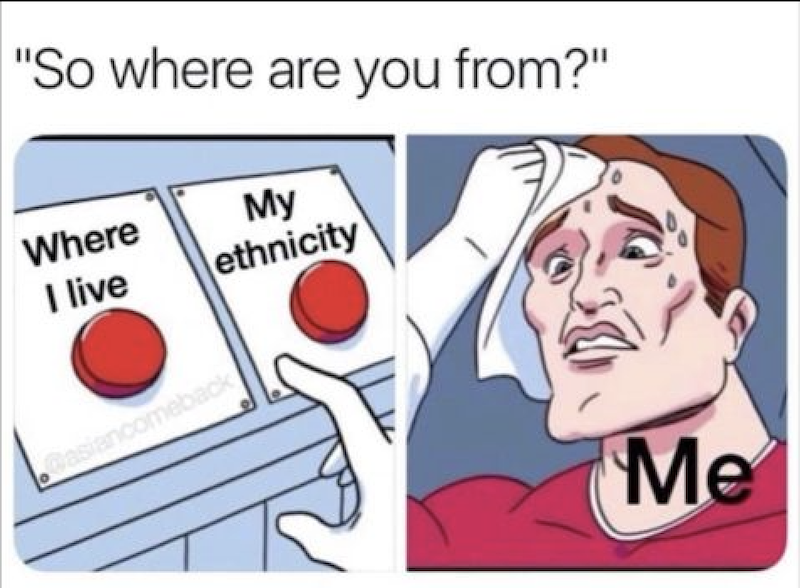
In posting the following memes, there was a discussion of whether I was obliged to ‘decode’ them for the ‘outsiders’. This left me in a complex position as the whole point of Subtle Asian Traits is that these experiences don’t need to be explained for the target audience (to be explored in greater depth below).

To put it succinctly, if not a bit crudely (my apologies) – if you don’t get it then it wasn’t made for you.

As of the beginning of June 2019 the Facebook group Subtle Asian Traits (SAT) has nearly 1.4 million members – one of many Subtle Traits groups inspired by the group Subtle Private School Traits (R.I.P.), it has taken news feeds by storm. Or at the very least, those belonging to the children of Asian diasporas. Created in September 2018 by a group of Melbourne friends who had met in Chinese school, it was merely meant to be a fun distraction from high school exams.

Ok, not to be lame, but this one actually made me laugh out loud. (Image Source: Yahoo)

SAT had humble beginnings: it was simply a small space to share jokes and memes that characterised the Asian-Australian experience; the “little things in our lives that no one talked about before” (Mao 2018), and most wouldn’t understand. Of course, the internet caught wind, and what had begun as a bit of fun instead tapped into something young, complicated and international. It has connected a borderless generation who are gradually coming into their own ethnic-national identity that is typically articulated as “too white to be asian but too asian to be white” (Lin 2018). There is a loneliness to being a diasporic Asian (not to mention a serious lack of representation), and with it comes a lack of belonging, to a nation or ethnic group (Wu and Yuan 2018). The constant bouncing between the culture of our heritage and that of the Western country we call home, and the struggles of being so ungrounded in place and culture is a complicated, exhausting experience to navigate or even articulate. For many SAT is a relief – “it’s a chance to belong for once without having to try” (Kwai 2018), nothing has to be explained, and for once another ‘insider‘ is putting words (or memes) to our experience. Finally, we have found a place that we can truly and unapologetically claim as our own.

This is not to imply that SAT is a perfect, safe multicultural haven. Not only is there a lack of representation of non-East Asians (specifically South Asians), but some critics argue that it perpetuates negative stereotypes (such as the ‘Tiger Mum’ and ‘Model Minority’), reinforces internalised racism and self-hate and makes joke of people’s own legitimate trauma and suffering (Mao 2018).

Anne Gu, co-founder, has responded to these criticisms, seeing the capacity to even express these negative experiences in the first place as “healing through humour” (Mao 2018), with the hope that people will come to have greater confidence and pride in their culture. The group aims to be as inclusive a space as possible, however it is ultimately dependent on the kind of posts people submit. (Image Source: Yahoo)

The idea of the ethnographic field as being “this town” or “this specific place” is becoming increasingly unraveled as space, both digital and physical, are redefined and people move with an increasing amount of frequency across the globe. Almost like an initiation rite in the anthropological academy, being able to understand and talk authoritatively about at least one place (and by extension being able to physically map/bound it) has traditionally been a key point of your academic identity (Kohn 2011). However anthropologists don’t study villages, they study in villages (Geertz 1973, p. 22) – “our real work is with people who happen to occupy a place in space… sometimes understanding [that] is not the most defining element of our encounter with them”. The community is not a static entity and cultural practices and identities are not bound to the ‘local’ (Coleman and Collins 2011). Rather than trying to fixate these communities in one moment of space and time, ’the field’ requires new ways of thinking as it it no longer (or ever was) a geographical location (Strauss 2000). Cultural capital constantly has to be reproduced, embodied and expressed through the individual, not by institutions or specific geographical locations (Coleman and Collins 2011).

It wouldn’t be a true SAT article without at least one boba meme (Source: KnowYourMeme)

For the majority of members of SAT, we have been brought up as hybrid children betwixt and between worlds – neither fully Asian nor fully Western – we have grown up living this experience of an unbounded and unmappable culture as our reality. Through SAT, we are finally getting a chance to articulate it and what it means (Wu and Yuan 2018) and in turn produce our own cultural capital.

Har gow slaps but go off (Image source: KnowYourMeme)

In an increasingly complex world, what a culture and what an ethnicity is is still being contested, and as anthropologists and ethnographers it can be difficult to do justice to that complexity. I think what SAT does is reveal a particular, increasingly prominent mode of cultural and ethnic experience that is not bounded by space or a singular ‘cultural’ distinction, but rather the in-between. These ideas aren’t new – people have always felt dislocated in culture and place through practices such as intermarriage. Rather the extent and breadth of them are becoming more fully realised outside academia. Through the global sphere of the Internet SAT has become a platform that has helped people explore their shared struggles and experiences in a safe space – a reminder that we’re not alone (Wu and Yuan 2018).

“We labeled the group [Facebook category] as ‘family,’ so that’s what the group’s purpose is, to allow people to feel like they all belong to something.” – Anne Gu, co-founder of SAT (Wu and Yuan 2018)

Banner Source


References:

Julia’s article on ‘The Field’

Coleman, S. and P. Collins  2011, Dislocating Anthropology?:  Bases of Longing and Belonging in the Analysis  of Contemporary Societies, Cambridge Scholars Publishing, Cambridge.

Geertz, C 1973, The Interpretation of Cultures, Basic Books, New York.

Kohn, T.  2011, ‘New Ways to Frame an Answer to ‘Where did you do your fieldwork?”, in Coleman, S. and P. Collins (eds.)  Dislocating Anthropology: Bases of longing and belonging in the analysis of contemporary societies, Cambridge Scholars Publishing, Cambridge, pp. 81-95.

Kwai, I 2018, ‘How ‘Subtle Asian Traits’ Became a Global Hit’, Article, New York Times, 11 Dec, viewed 7 June, <https://www.nytimes.com/2018/12/11/world/australia/subtle-asian-traits-facebook-group.html&gt;

Lin, K 2018, ‘The Story of the Subtle Asian Traits Facebook GroupLin, Article, The New Yorker, 22 Dec, viewed 7 June, <https://www.newyorker.com/culture/culture-desk/the-story-of-the-subtle-asian-traits-facebook-group&gt;

Mao, F 2018, ‘Subtle Asian Traits: When memes become a diaspora phenomenon’, Article, 19 Dec, BBC, viewed 7 June, <https://www.bbc.com/news/world-australia-46394931&gt;

Strauss, S. 2000,  ‘Locating Yoga: ethnography and transnational practice’, in Amit, V . (ed) Constructing the Field: Ethnographic Fieldwork in the Contemporary World, Routledge, London, pp. 162- 194.

Wu, N and Yuan, K 2018, ‘The Meme-ification of Asianness’, Article, The Atlantic, 27 Dec, viewed 7 June, <https://www.theatlantic.com/technology/archive/2018/12/the-asian-identity-according-to-subtle-asian-traits/579037/&gt;

And for a bit of pop culture:

If you want to smile (because we’re finally being represented in Hollywood): peruse through Fresh Off the Boat, To All the Boys I’ve Loved Before, Always Be My Maybe, and Crazy, Rich Asians (probably not a shock to any Asians reading this). Abominable is coming out later this year; and Bao made us all cry last year, and although no other Sandra Oh role will ever be as iconic as Vice Principal Gupta in The Princess Diaries, Killing Eve gets pretty close.

And I know it’s cheesy, but it’s also iconic (I literally only got a Stan account to watch it): Bend it Like Beckham

One Day at a Time, although a show about a Cuban-American family living in LA, has never made me feel so ‘seen’ as a migrant (the queer representation, generational and cultural divides and family structure certainly help). It’ll make you laugh and cry your heart out.

The Astonishing Color of After is a wonderful coming-of-age novel. The Kiss Quotient is a sweet romance, and Ms. Marvel is great for all the superhero fans out there. The Wrath and the Dawn and An Ember in the Ashes are both beautiful fantasy novels, and Warcross is pure, fun sci-fi.